Create an EU battery passport
An EU battery passport is mandatory from 18 February 2027 for every LMT, industrial (above 2 kWh) and electric vehicle battery. It carries the public data from Annex XIII and a contact for everything else.
Create a passport in the editor
Which batteries need a passport
Under Art. 77(1) of the Batteries Regulation, from 18 February 2027 every battery placed on the market or put into service needs a battery passport if it is:
- an LMT battery, for light means of transport such as e-bikes and e-scooters, regardless of capacity
- an industrial battery with a capacity above 2 kWh
- an electric vehicle battery
Portable and SLI (starter) batteries need no passport, but from the same date they carry a QR code that leads to their required information (Art. 13(6)).
What the public can see
Annex XIII point 1 lists the battery model data open to everyone:
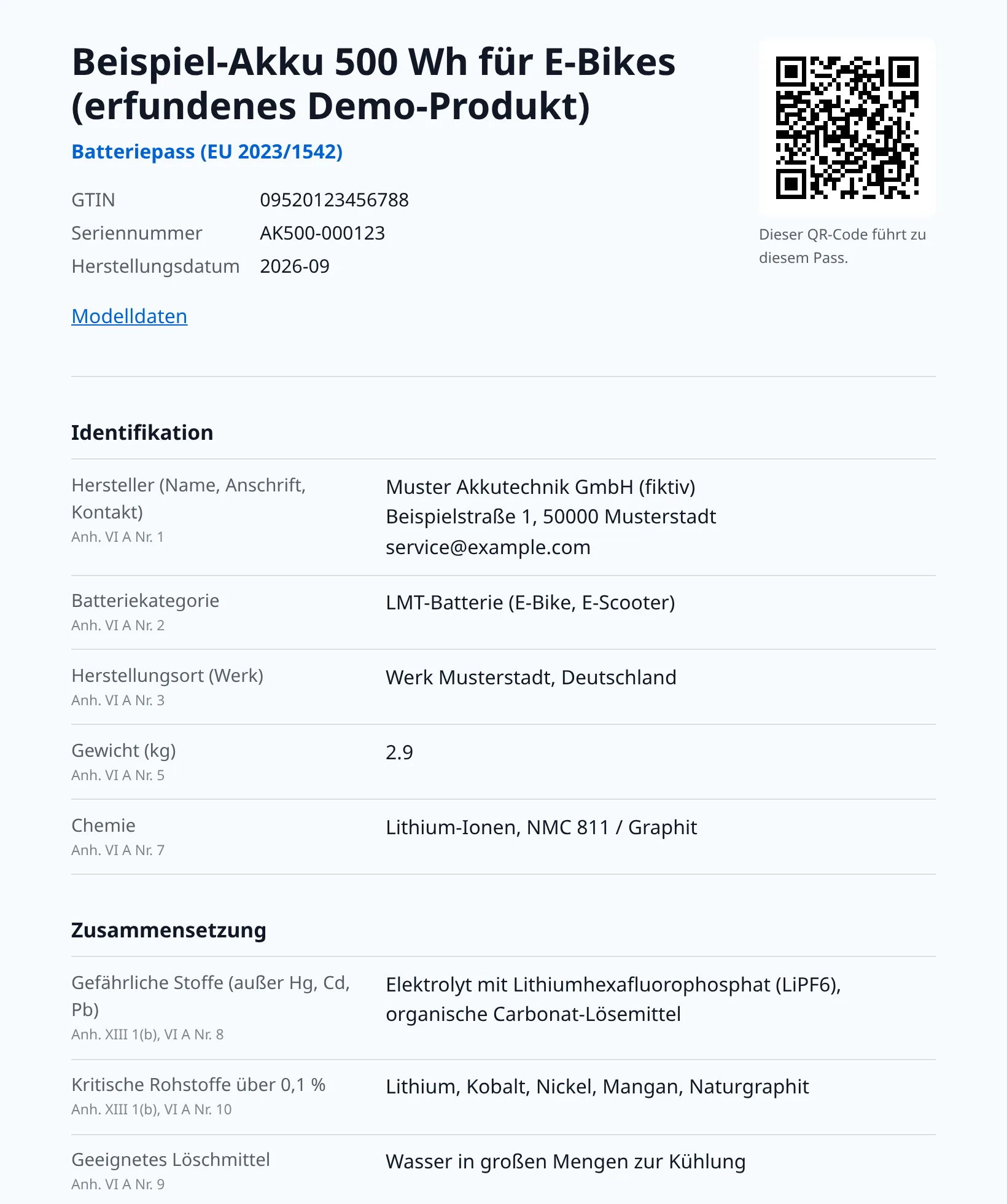
- Label data from Annex VI Part A: manufacturer, category, place and date of manufacture, weight, capacity, chemistry, hazardous substances, extinguishing agent and critical raw materials above 0.1 % by weight
- Origin and environment: material composition, carbon footprint, due diligence report, recycled content, renewable content
- Performance and durability: rated capacity, voltages, power, expected lifetime in cycles with the reference test, temperature range, warranty, round-trip efficiency, internal resistance, C-rate; for EV batteries the capacity threshold for exhaustion
- Conformity: markings under Art. 13, the EU declaration of conformity and take-back and recycling information under Art. 74
What only authorised parties may see
- Point 2, persons with a legitimate interest and the Commission: detailed cathode, anode and electrolyte composition, part numbers and spare part sources, dismantling information, safety measures
- Point 3, notified bodies, market surveillance and the Commission only: test reports
- Point 4, per individual battery: performance values, state of health, status (original, re-used, repurposed, remanufactured or waste) and usage data such as charge cycles
An implementing act under Art. 77(9) defines who counts as having a legitimate interest. Passwerk publishes point 1 only and shows a contact for the rest. It does not build access control.
QR code and unique identifier
The passport is reached through the QR code, which links to a unique identifier compliant with ISO/IEC 15459 parts 1 to 6 (Art. 77(3)). GS1 is an issuing agency under that series, so a GTIN with a serial number meets the requirement. Passwerk publishes each page at a GS1 Digital Link path, /01/<GTIN>/21/<serial>/, and draws the QR code with error correction level M and a quiet zone.
Requirements for the system
Art. 77(5) asks for open standards and a machine-readable, structured, searchable format without vendor lock-in. Passwerk writes the data as JSON and as a schema.org Product inside each page; the files live in your repository. Art. 78 adds free access and that the passport stays available if your company stops trading. A GitHub account alone does not guarantee the last point, so mirror the pages on your own domain.
Create the passport with Passwerk
- Open the editor (German interface) and pick the battery template.
- Fill in the fields or let Claude read the datasheet. Each AI suggestion stays marked until you change it.
- Download the JSON file and put it in
passports/in your fork. - After the push, GitHub Actions builds the pages. Each serial number gets its
qr.svgnext to its page.
Short answers
- When does the EU battery passport apply?
- From 18 February 2027 for LMT, industrial (above 2 kWh) and electric vehicle batteries (Art. 77(1) of Regulation (EU) 2023/1542).
- Does an e-bike battery need a battery passport?
- Yes. E-bike batteries are LMT batteries and need a battery passport from 18 February 2027, whatever their capacity.